

In this article
- Why prepare Dover sole yourself?
- Video: Watch Rick Stein prepare and cook Dover sole
- How to prepare Dover sole: a step-by-step guide
- Rick Stein’s top tips
- Frequently asked questions
Preparing a whole Dover sole may sound like a job best left to the fishmonger, but it’s a straightforward technique that’s well worth learning. Once you’ve done it once, you’ll be able to prepare the fish confidently at home whenever it’s on the menu.
In this step-by-step guide, Rick Stein demonstrates how to descale a Dover sole, remove its thick outer skin, and neatly fillet and serve the fish after cooking. These simple techniques will help you get the best from one of Britain’s finest flatfish, whether you’re pan-frying, grilling or baking it.
Why prepare Dover sole yourself?
Dover sole is prized for its delicate flavour and firm, fine-textured flesh. While it can be bought ready-prepared, knowing how to trim, skin and bone the fish yourself means you can buy it whole and prepare it exactly as you need it.
Unlike many other flatfish, Dover sole has a thick, rubbery skin that is usually removed before cooking as it turns more gelatinous than crispy during the cooking process. Once cooked, the backbone can also be lifted away in one piece, making it one of the easiest types of fish to serve neatly at the table.
Video: Watch Rick Stein prepare and cook Dover sole
How to prepare Dover sole
1. Descale the fish
Many fishmongers sell Dover sole already descaled, so check your fish before you begin.
If it still has scales, use a fish scaler or the back of a knife to scrape from the tail towards the head, working against the direction of the scales.
Tip: Dover sole has surprisingly tough scales, so working against the grain helps lift them away more easily.
2. Trim the fins
Using kitchen scissors or a sharp knife, trim away the lateral fins on both sides of the fish.
Work from the tail towards the head, cutting as close to the body as possible.
3. Loosen the skin
Lay the fish dark-side up on a chopping board.
Using a sharp knife, make a small incision through the skin close to the tail, then carefully slide the blade underneath to loosen enough skin to grip.
4. Peel away the skin
Sprinkle a little salt over both the tail and the loose skin to improve your grip.
Holding the skin firmly, pull it steadily towards the head in one smooth movement until it comes away. Turn the fish over and repeat on the second side.
Tip: The skin is thick and rubbery, so the salt helps prevent it slipping through your fingers.
5. Cook the fish
Once prepared, Dover sole can be pan-fried, grilled or baked.
If you’re cooking it on the bone, Rick Stein recommends cooking the fish until it reaches an internal temperature of around 60°C. At this point, the flesh will release cleanly from the bones while remaining moist and delicate.
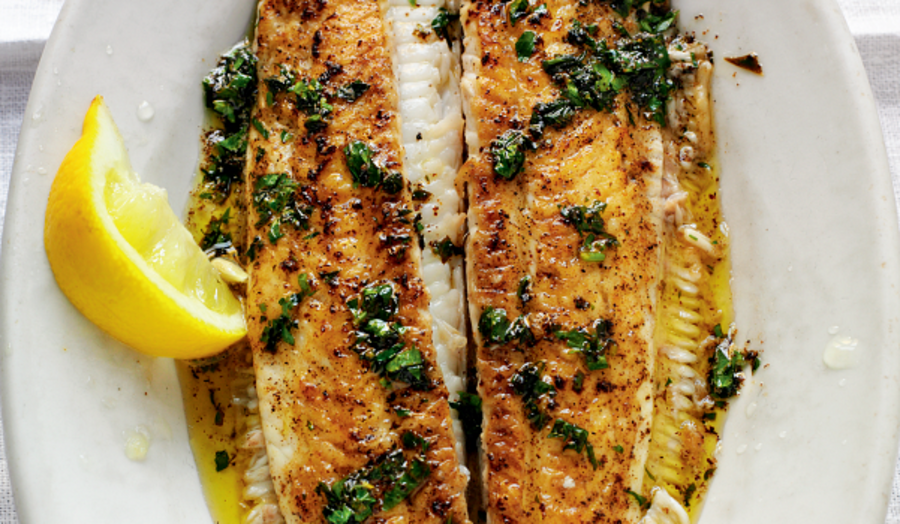
Looking for a classic way to cook your fish? Try Rick Stein’s Dover Sole à la Meunière, where the fish is lightly floured, pan-fried and served with beurre noisette with lemon and parsley.
6. Remove the backbone
Transfer the cooked fish to a chopping board and remove the small lateral bones around the edge first.
Run a knife gently along either side of the backbone, ease the fillets apart slightly, then lift out the backbone in one piece before laying the fillets back into place for serving.
Rick Stein’s top tips
- Check whether your Dover sole has already been descaled before you begin.
- Always work from the tail towards the head when descaling and trimming the fins.
- Sprinkle a little salt over the skin to improve your grip while peeling it away.
- Pull the skin away in one smooth movement rather than several short tugs.
- If you’re cooking the fish on the bone, aim for an internal temperature of around 60°C before removing the backbone.
Frequently asked questions
Do you need to skin Dover sole before cooking?
For most cooking methods, yes. Dover sole has a thick, rubbery skin that can become tough during cooking, so it is usually removed before the fish goes into the pan, oven or under the grill.
Do you need to descale Dover sole?
Many fishmongers sell Dover sole already descaled, but it’s always worth checking before you begin preparing the fish.
Can you cook Dover sole with the skin on?
You can, but most chefs prefer to remove it first because it improves both the texture and presentation of the finished dish. The skin of Dover sole turns gelatinous rather than crispy when cooked, so skinning the fish before cooking ensures a much better texture.
Is Dover sole difficult to de-bone?
No. Once properly cooked, Dover sole is one of the easiest fish to de-bone. The backbone can usually be lifted away in one piece, leaving the fillets intact.
How do you know when Dover sole is cooked?
If you’re cooking Dover sole on the bone, aim for an internal temperature of around 60°C. At this temperature, the flesh is cooked through but still moist, and the bones separate cleanly from the fillets.
What’s the best way to cook Dover sole?
Dover sole is particularly well-suited to pan-frying because its firm flesh holds together beautifully. For a classic French recipe, try Rick Stein’s Dover Sole à la Meunière, served with brown butter, lemon and parsley.
Find this recipe and more in

Rick Stein’s Fish & Shellfish

The definitive guide to fish and shellfish

Innovative versions of favourite seafood dishes

Failsafe prep and cooking instructions